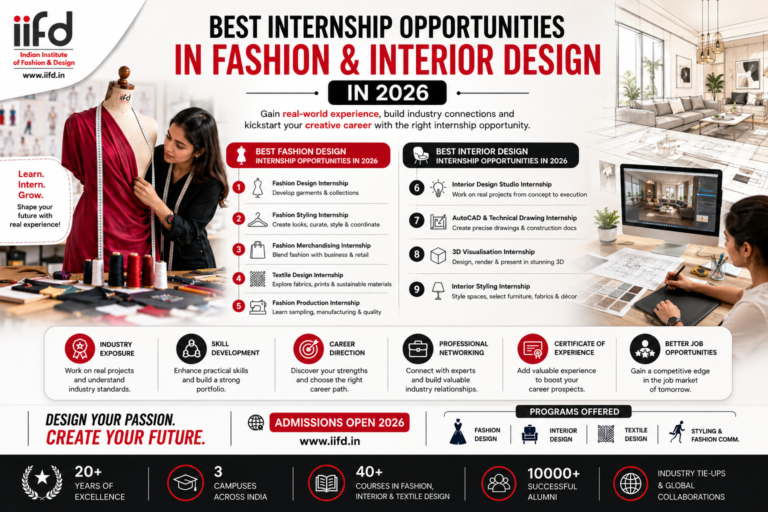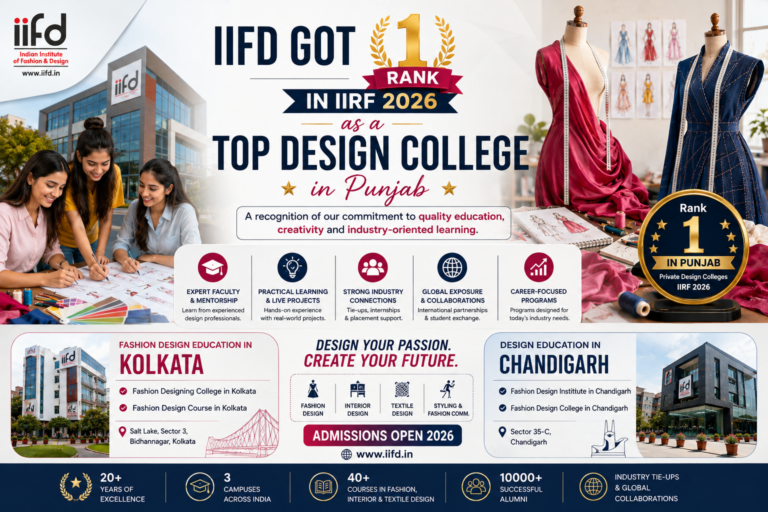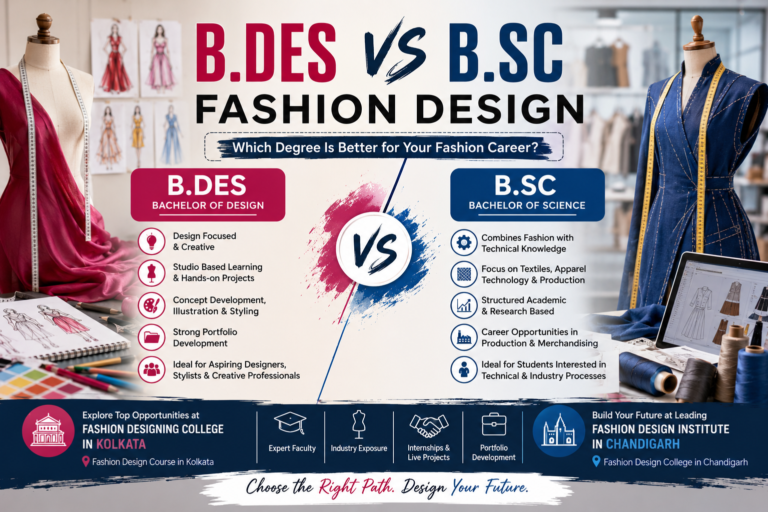
Choosing a fashion institute is about much more than selecting a college with an attractive campus or a long list of courses. Students usually compare curriculum, practical training, industry exposure, faculty experience, portfolio development, career support, location and institutional recognition before making a decision.
The Indian Institute of Fashion & Design (IIFD) has built its position in this competitive design-education landscape through more than two decades of operation, a broad range of fashion and design courses, practical learning opportunities and campuses in Chandigarh, Mohali and Kolkata. IIFD currently states on its official website that it secured 5th position pan India among the top 40 private design colleges in an IIRF ranking.
There is an important distinction, however. The published ranking refers to private design colleges, rather than a ranking exclusively limited to fashion institutes. Therefore, the 5th-position claim should be understood in that context. For students researching the Best Fashion Design College in India, this distinction makes the comparison more meaningful because ranking is only one part of evaluating an institute.
So, what makes IIFD stand out? The answer lies in the combination of its institutional experience, course range, practical curriculum, industry interaction, student work, career preparation and presence in established design markets.
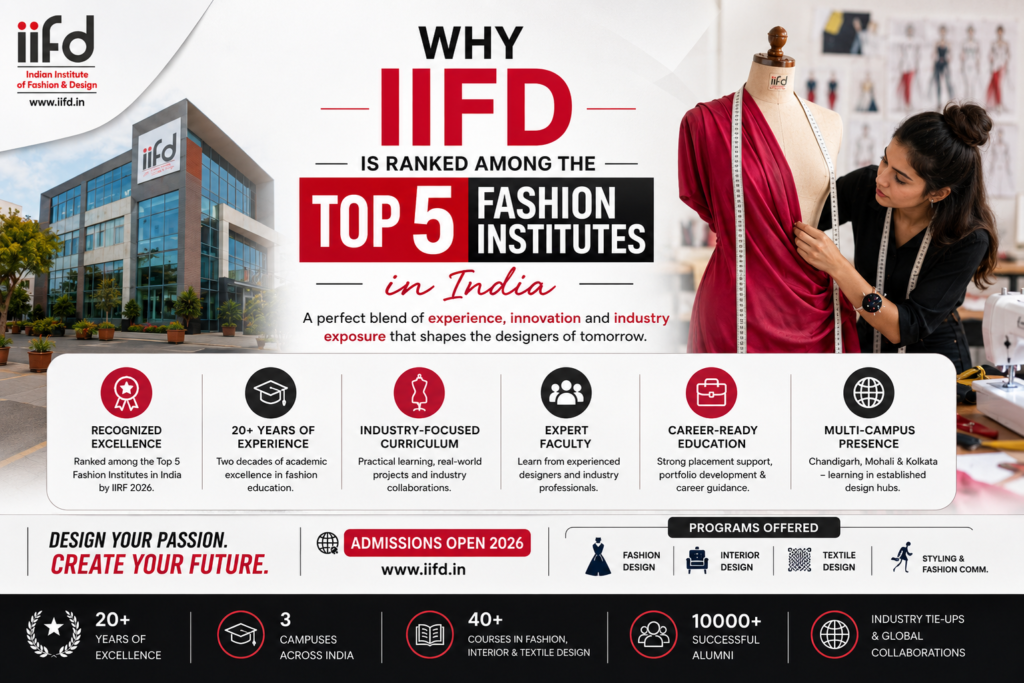
IIFD Ranking: What Does the 5th Position Actually Mean?
IIFD’s official website currently highlights a 5th rank pan India among the top 40 private design colleges by the IIRF ranking. The same claim appears on its Kolkata campus page.
This is worth explaining clearly because students often use terms such as “top fashion college,” “top design institute” and “best fashion college” interchangeably.
A private design-college ranking can cover a broader design category, while fashion education represents one part of that larger field. Therefore, the ranking should not be interpreted as an exclusive ranking of India’s five best fashion-only institutes.
Instead, it provides one external recognition point that students can consider alongside other factors such as:
- Academic Courses
- Curriculum structure
- Practical studio work
- Industry interaction
- Portfolio development
- Faculty expertise
- Student projects
- Career preparation
- Campus facilities
- Institutional experience
This approach gives prospective students a more balanced way to evaluate IIFD rather than relying on a single ranking number.
IIFD at a Glance
| Factor | IIFD Information |
|---|---|
| Institute | Indian Institute of Fashion & Design |
| Established | 2004, according to IIFD’s published institutional information |
| Published ranking claim | 5th pan India among top 40 private design colleges in an IIRF ranking |
| Campuses | Chandigarh, Mohali and Kolkata |
| Main disciplines | Fashion, textile and interior design |
| Courses range | 40+ fashion/design Courses claimed by IIFD |
| Learning approach | Studio work, projects, workshops and industry interaction |
| Fashion Courses | Diploma, B.Sc., B.Des., postgraduate and specialized Courses |
| Industry exposure | Industry visits, seminars, fashion shows and professional interactions |
| Career preparation | Training and placement support |
IIFD’s official course listings include diploma, undergraduate, postgraduate and specialized fashion Courses. Its current course pages include options such as B.Sc. Fashion Design, B.Des. Fashion Design, M.Des., M.Sc., MBA Fashion Design and advanced diploma Courses.
1. More Than Two Decades of Design Education
Experience matters in design education because fashion is not simply a theoretical subject. Students need time to develop visual thinking, technical skills, design vocabulary and the ability to convert an idea into a finished product.
IIFD traces its institutional journey back to 2004. Over the years, the institute has developed Courses across fashion, textile and interior design while expanding its campus presence. Its current contact information lists locations in Chandigarh, Mohali and Kolkata.
That history provides an important context for students comparing newer design schools with institutes that have been operating for a longer period.
However, longevity alone does not make an institute the right choice. The more useful question is whether that experience translates into a relevant curriculum and meaningful student learning. This is where IIFD’s Courses structure and practical approach become important.
2. A Broad Fashion and Design Curriculum
Fashion education has changed significantly. Today’s designer may need to understand illustration, textiles, pattern development, CAD, garment construction, merchandising, branding, digital design and consumer behavior.
IIFD’s published Course portfolio reflects this broader approach. Its fashion-design course listings cover subjects ranging from fashion illustration and pattern making to textiles, CAD, merchandising, portfolio development and garment construction.
For example, the B.Sc. Fashion Design curriculum published by IIFD includes areas such as:
- Fashion illustration
- Apparel design
- Pattern making
- Textiles
- CAD design
- Colour theory
- Fashion merchandising
- Portfolio development
- Garment construction
- Retail management
- Visual merchandising
- Digital fashion design
The institute also lists specialized areas such as fashion styling and forecasting, luxury brand management, garment manufacturing technology and 3D fashion design.
This variety is useful because students do not necessarily enter the fashion industry with the same career objective. One student may want to become a designer, while another may be more interested in styling, merchandising, fashion communication, production or brand management.
3. Practical Learning Instead of Classroom Theory Alone
Fashion is a hands-on discipline. A student can understand design theory yet still struggle to develop a garment, construct a pattern or present a professional collection.
That is why practical learning becomes one of the most important factors when comparing design institutes.
IIFD’s published course information places considerable emphasis on studio practice, projects and technical development. Its B.Sc. Course, for instance, includes pattern making, textiles, CAD, portfolio work and a final collection, while the institute describes an annual fashion-show component as part of the practical learning experience.
Its diploma Course similarly covers foundation design, sewing techniques, fabric embellishment, textile work, fashion illustration, pattern making, CAD and portfolio development.
This approach allows students to gradually move through the design process:
Idea → Research → Sketch → Material Selection → Pattern → Construction → Finishing → Presentation
That progression is important because professional fashion work rarely stops at a sketch.
4. Portfolio Development Gives Students Something Tangible to Show
A fashion student’s portfolio can become one of the most useful pieces of evidence when applying for internships, jobs, higher education or freelance opportunities.
Instead of simply collecting certificates, students need to demonstrate what they can actually create.
IIFD’s published curricula include portfolio and project work across its fashion Courses. The B.Sc. Course, for example, incorporates portfolio development and project work, while its final-year structure includes a self-initiated collection and presentation through a fashion show.
This creates an important distinction between learning about fashion and demonstrating fashion-design ability.
A strong portfolio can include:
- Fashion illustrations
- Mood boards
- Textile experiments
- Technical drawings
- CAD work
- Pattern development
- Garment samples
- Completed collections
- Styling projects
- Research projects
- Brand or merchandising concepts
For students evaluating fashion schools, therefore, it is worth asking to see examples of actual student work rather than judging an institute only by its brochure.
5. Industry Exposure Connects Education With Professional Practice
Another reason IIFD attracts attention is its focus on industry interaction.
The institute’s published training and placement information features industry-related activities, recruiters and professional collaborations. Its website also displays associations involving organizations and brands including Satya Paul, Marks & Spencer, Times of India and Punjab Bespoke, among others.
Industry exposure can take different forms. Students may benefit from:
- Industry visits
- Expert seminars
- Workshops
- Fashion events
- Professional interactions
- Live projects
- Internships
- Portfolio reviews
- Fashion shows
The value of such activities depends on the quality and relevance of each engagement. Consequently, prospective students should look beyond a list of company logos and ask what students actually did during these collaborations.
That is a more reliable way to assess industry exposure.
6. Fashion Education in Chandigarh
Chandigarh has developed into an important education and design destination for students from Punjab, Haryana, Himachal Pradesh and neighboring regions.
IIFD’s Chandigarh campus is located in Sector 35-C. Its official contact page also lists its Mohali campus in Industrial Area Phase 9.
For students searching for the Best Fashion Design College in Chandigarh, location can be one factor, but it should not be the only deciding point.
A good evaluation should consider:
- Course duration
- Eligibility
- Curriculum
- Studio facilities
- Faculty
- Practical training
- Industry interaction
- Portfolio opportunities
- Student work
- Career support
- Total cost of education
IIFD’s Chandigarh Courses include diploma, undergraduate and postgraduate pathways. Its current fashion-course listings include B.Sc., B.Des., postgraduate Courses and specialized options alongside diploma routes.
The range allows students to choose a pathway according to their academic background and career plans.
7. What Makes Fashion Design Courses in Chandigarh Relevant?
The value of studying fashion in Chandigarh extends beyond the classroom.
A student can use the city as a base for developing a portfolio, attending design events, interacting with creative professionals and exploring opportunities across the wider North Indian market.
IIFD’s published fashion Courses combine creative subjects with technical areas such as pattern making, textile studies, CAD, garment construction and merchandising.
That combination matters because the modern fashion industry includes considerably more than designing clothes.
Potential career areas include:
- Fashion design
- Fashion styling
- Textile design
- Fashion illustration
- Fashion merchandising
- Pattern making
- Production
- Visual merchandising
- Fashion communication
- Brand management
- Fashion entrepreneurship
Therefore, students should evaluate a Course based on the skills it develops rather than selecting a course simply because the course title contains “fashion design.”
8. IIFD’s Fashion Design Presence in Kolkata
Kolkata has a distinct design and textile heritage, making it an interesting location for students interested in fashion, textiles, crafts and creative industries.
IIFD operates a Kolkata campus in Salt Lake, Bidhannagar. The institute’s official Kolkata page also highlights its published IIRF ranking claim and describes its collaboration with Times Lifestyle Week.
For students looking for a Fashion Designing Institute in Kolkata, the location offers another way to approach fashion education while remaining connected to the city’s established cultural and textile environment.
The important consideration, again, is the actual learning experience.
Students should investigate:
- Course structure
- Studio facilities
- Faculty
- Practical assignments
- Student collections
- Industry activities
- Internship opportunities
- Career support
- Course fees
- Course duration
This kind of comparison produces a more useful decision than simply searching for a college with the highest-sounding ranking.
9. Fashion Design Courses in India: Why Course Variety Matters
There is no single route into the fashion industry.
Some students begin after Class 10 through a diploma. Others enter an undergraduate course after Class 12. Graduates may choose postgraduate education or specialize in areas such as fashion management, styling, communication or advanced design.
IIFD currently publishes several types of fashion Courses, including diploma, B.Sc., B.Des., M.Sc., M.Des., MBA and specialized Courses.
For example:
Diploma Courses
These can provide foundational exposure to fashion illustration, sewing, textiles, pattern development and CAD. IIFD’s published diploma Courses has a one-year route for eligible students and covers core fashion-design skills.
Undergraduate Courses
The B.Sc. Fashion Design Course listed by IIFD runs for three years, while the institute also lists a four-year B.Des. Fashion Design Course.
Postgraduate Courses
IIFD lists postgraduate options including M.Sc. and M.Des. Fashion Design, along with MBA Fashion Design.
Specialized Courses
Students can also explore areas such as fashion styling, forecasting, luxury brand management, garment manufacturing technology and 3D fashion design.
This variety allows students to select a course according to their previous education and intended career direction.
10. Industry-Oriented Skills Are Becoming More Important
Fashion professionals increasingly work across creative and technical disciplines.
A designer may use traditional sketching alongside digital tools. A stylist may need knowledge of trends and visual communication. A merchandiser may need an understanding of consumer behavior and retail. A fashion entrepreneur may need design knowledge as well as business skills.
IIFD’s published curriculum reflects several of these connections through subjects such as CAD, textiles, merchandising, retail management, visual merchandising and digital fashion design.
Its B.Voc. course also describes a practical learning model involving studio practice, workshops and live design projects, covering areas such as fashion illustration, textiles, pattern making, garment construction, draping and digital fashion design.
This multidisciplinary approach is particularly relevant for students who want flexibility after graduation.
11. Training and Placement Support
Career preparation is another area students should investigate before joining any design institute.
IIFD maintains a dedicated training and placement section on its website and publishes examples of industry and recruiter relationships.
The institute also publishes placement figures on its website. Because placement percentages can depend on the methodology, graduating batch, definition of placement and reporting period, students should ask the admissions team for the latest placement report and supporting details before treating any percentage as a guarantee.
This is an important point when comparing colleges.
A placement claim becomes more useful when students can understand:
- Which graduating batch does it cover?
- How many students participated?
- What roles did students receive?
- Which companies recruited?
- What was the median or average salary?
- Were internships counted separately?
- How many students pursued higher studies or entrepreneurship?
These questions help students make decisions based on evidence rather than marketing claims.
12. Awards, Recognition and Industry Associations
Awards can provide another indication of institutional visibility, but they should always be evaluated alongside the award category, year and awarding organization.
IIFD’s website currently highlights its 5th-place IIRF ranking claim and also lists a “Most Emerging Design Institute” award from 2023. Its Kolkata page additionally highlights a collaboration with Times Lifestyle Week.
For prospective students, the useful approach is to ask:
What was the award for?
Who presented it?
Which year was it received?
What category did the institute win?
That context makes awards considerably more meaningful.
13. Why IIFD Can Be Considered by Students Comparing Private Design Institutes
A strong design institute should not be judged by one feature.
Instead, students should look at the complete learning ecosystem.
IIFD’s current public information presents several components that can be evaluated together:
Institutional experience
The institute traces its journey to 2004.
Course variety
Its published course catalogue covers diploma, undergraduate, postgraduate and specialized courses.
Practical curriculum
Published courses include design projects, portfolio work, pattern making, textiles, CAD and garment construction.
Industry interaction
IIFD publishes information about industry visits, seminars, collaborations and recruiter relationships.
Multiple locations
The institute currently lists campuses in Chandigarh, Mohali and Kolkata.
National recognition claim
IIFD currently publishes a 5th-place position among the top 40 private design colleges under an IIRF ranking.
Taken together, these factors explain why IIFD can attract attention from students researching private design education in India.
IIFD vs Other Fashion Design Colleges: What Should Students Compare?
Students searching for the Best Fashion Design College in Chandigarh or another city should avoid relying on rankings alone.
A useful comparison can look like this:
| Factor | What Students Should Check |
|---|---|
| Ranking | Ranking body, year and category |
| Curriculum | Subjects, practical work and specializations |
| Faculty | Qualifications and industry experience |
| Portfolio | Quality of actual student work |
| Practical training | Studio projects and technical work |
| Industry exposure | Workshops, visits, internships and live projects |
| Placement | Latest batch data and recruiter information |
| Location | Access to relevant creative and professional networks |
| Facilities | Studios, labs, CAD and other learning resources |
| Fees | Complete course cost |
| Career options | Design, styling, merchandising, production and other pathways |
| Student experience | Events, exhibitions, shows and collaborative activities |
This comparison framework can be applied to IIFD as well as other fashion and design institutes.
Is IIFD the Right Choice for Every Fashion Student?
No single institute is automatically the right choice for every student.
A student interested in fashion design should first identify the type of career they want to pursue. Someone interested in garment construction may prioritise technical training. Another student may care more about styling, fashion communication, merchandising or luxury brand management.
The same applies to location.
Someone searching for a fashion institute in Chandigarh may value proximity and access to the North Indian design ecosystem. A student considering Kolkata may place greater importance on the city’s textile and cultural environment.
Therefore, IIFD should be evaluated against the student’s:
- Career objective
- Academic qualification
- Preferred course
- Budget
- Preferred campus
- Learning style
- Desired specialization
- Portfolio goals
- Career expectations
This makes the decision more personal and much more useful than simply choosing an institute because it appears on a “top colleges” list.
What Students Should Verify Before Taking Admission
Even when an institute has strong rankings or recognition, students should perform their own due diligence.
Before applying, prospective students should:
- Review the latest curriculum.
- Visit the campus if possible.
- Ask to see current student work.
- Speak with faculty members or academic counselors.
- Understand the complete fee structure.
- Confirm eligibility requirements.
- Check course duration.
- Ask about internship opportunities.
- Request current placement information.
- Verify the awarding body or university affiliation applicable to the specific course.
- Understand what certificate or degree will be awarded.
- Compare the course with at least two or three alternatives.
This approach protects students from making an important education decision based on a single promotional claim.
Frequently Asked Questions
Is IIFD ranked among the top 5 fashion institutes in India?
IIFD currently states that it was ranked 5th pan India among the top 40 private design colleges in an IIRF ranking. The published category is broader than fashion-only institutes, so students should understand the ranking in its correct private-design-college context.
What makes IIFD different from other fashion institutes?
IIFD combines a broad course portfolio with practical design work, portfolio development, industry interaction and multiple campuses. Its published courses cover areas including fashion design, textiles, CAD, merchandising, styling, luxury brand management and digital fashion.
Is IIFD a good option for students after Class 12?
IIFD offers undergraduate fashion courses for students who have completed 10+2 or an equivalent qualification. Its current listings include B.Sc. Fashion Design and B.Des. Fashion Design, subject to the eligibility requirements of the individual course.
What fashion courses does IIFD offer?
Its published course catalogue includes diploma, B.Sc., B.Des., M.Sc., M.Des., MBA and specialized fashion course. The exact duration and eligibility depend on the course.
Does IIFD focus only on fashion design?
No. IIFD’s course portfolio also includes interior and related design disciplines. Its course catalogue includes fashion, interior and specialized design courses.
What practical skills can students develop?
Depending on the course, students can work on fashion illustration, textiles, pattern making, garment construction, CAD, draping, merchandising, portfolio development and collection projects.
Where are IIFD campuses located?
IIFD currently lists campuses in Chandigarh, Mohali and Kolkata. The Chandigarh campus is in Sector 35-C, while the Kolkata campus is located in Salt Lake, Bidhannagar.
Is IIFD suitable for students looking for fashion education in Kolkata?
IIFD operates a Kolkata campus and offers fashion and design education there. Students should compare the specific course, faculty, facilities, practical opportunities and fees before making a decision.
Does IIFD provide industry exposure?
IIFD publishes information about industry visits, seminars, fashion shows, professional interactions and industry collaborations. Students should ask for details of current activities and opportunities available to their specific course.
Can ranking alone determine the best fashion college?
No. A ranking is only one evaluation factor. Curriculum, faculty, practical learning, student work, industry exposure, fees, career support, location and the specific qualification awarded should also influence the decision.