Choosing the right undergraduate degree can shape a student’s creative direction, practical skills, and career opportunities in the fashion industry. Two popular options are B.Des (Bachelor of Design) and B.Sc (Bachelor of Science) in Fashion Design. Although both programs prepare students for careers in fashion, their learning approaches, curriculum structures, and areas of specialization can differ significantly.
For students comparing these two degrees, the key question is not simply which course is better. Instead, the better choice depends on the student’s interests, career goals, preferred learning style, and long-term plans.
What Is a B.Des in Fashion Design?
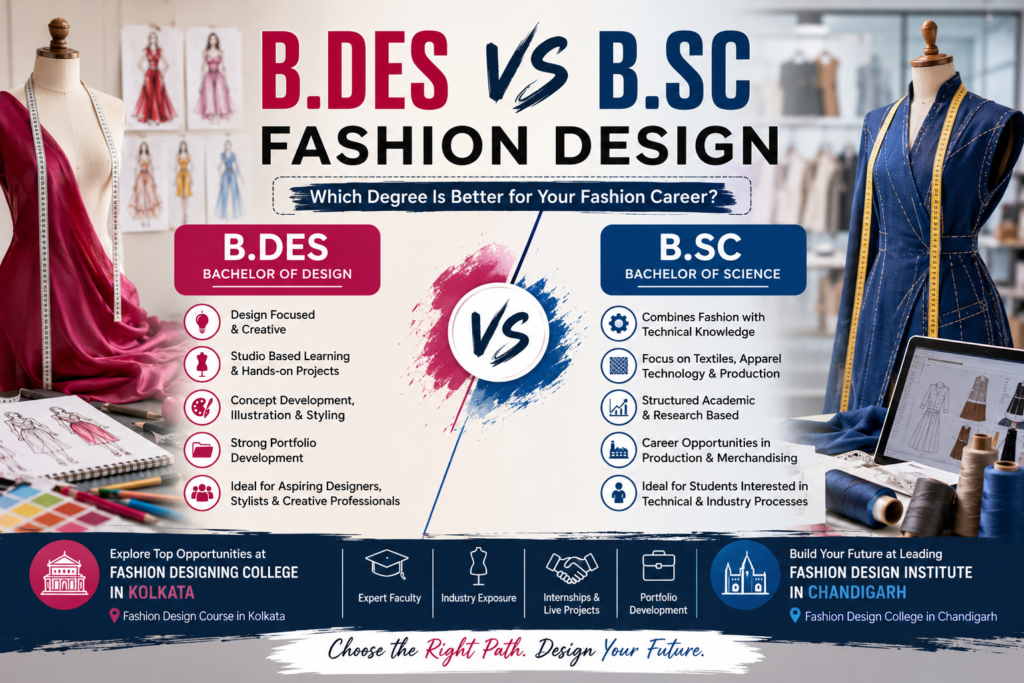
B.Des in Fashion Design is primarily a design-focused undergraduate program. It develops creative thinking, design concepts, visual communication, garment development, and practical understanding of the fashion industry.
The curriculum usually combines classroom learning with studio-based projects. Students may explore areas such as:
- Fashion illustration
- Design development
- Pattern making
- Garment construction
- Textile studies
- Fashion styling
- Fashion communication
- Draping techniques
- Trend research
- Portfolio development
Because the program focuses strongly on creative development, students often work on design projects throughout their academic journey. Therefore, B.Des can suit students who enjoy experimentation, visual storytelling, and developing original fashion concepts.
What Is a B.Sc in Fashion Design?
B.Sc in Fashion Design combines fashion education with a more structured and technical academic approach. While students still study design fundamentals, the course can place greater emphasis on textiles, garment technology, production processes, materials, and the scientific or technical aspects of fashion.
Depending on the institution, students may study:
- Textile science
- Apparel production
- Fabric studies
- Garment manufacturing
- Fashion design fundamentals
- Pattern development
- Fashion merchandising
- Quality management
- Computer-aided design
- Apparel technology
As a result, B.Sc Fashion Design can be suitable for students who want to understand both fashion design and the technical processes involved in apparel development.
B.Des vs B.Sc Fashion Design: Key Difference
The biggest difference between B.Des and B.Sc Fashion Design generally lies in their academic orientation.
| Factor | B.Des Fashion Design | B.Sc Fashion Design |
|---|---|---|
| Primary focus | Design and creativity | Fashion, science and technical knowledge |
| Learning style | Studio and project oriented | Technical and academic |
| Creativity | Strong emphasis | Important but balanced with technical learning |
| Technical knowledge | Moderate to strong | Strong emphasis |
| Practical projects | Extensive | Regular |
| Career direction | Designer, stylist, creative professional | Designer, apparel professional, production or technical roles |
| Suitable for | Creative and design-oriented students | Students interested in design and technical processes |
However, the actual curriculum can vary between institutions. Therefore, students should always review the official syllabus, studio facilities, internships, faculty profiles, and industry exposure before selecting a program.
Curriculum Comparison: B.Des vs B.Sc
B.Des Curriculum
A B.Des curriculum usually encourages students to think creatively and develop their own design language. Studio projects can form a major part of the learning experience.
Students may create mood boards, fashion illustrations, collections, prototypes, and portfolios. Furthermore, industry projects can help them understand how a design moves from an initial idea to a finished product.
B.Sc Fashion Design Curriculum
B.Sc programs can provide a broader technical foundation. Alongside fashion design, students may study fabrics, apparel production, textile technology, merchandising, and quality control.
This approach can benefit students who want to understand the complete apparel development process rather than focusing exclusively on creative design.
Which Degree Is More Creative?
Students who want a strongly creative learning environment may prefer B.Des. The program typically provides more opportunities for experimentation, conceptual development, visual research, and collection creation.
On the other hand, B.Sc Fashion Design can still provide considerable creative exposure. However, its curriculum may balance creativity with technical and scientific subjects.
Therefore, students who see themselves primarily as fashion designers may find B.Des more aligned with their interests, while students who enjoy both creativity and technical processes may consider B.Sc.
Which Degree Offers Better Career Opportunities?
Both degrees can lead to fashion-related careers. However, career outcomes depend on several factors, including the institution, portfolio quality, internships, technical skills, communication abilities, and industry exposure.
B.Des graduates may explore careers such as:
- Fashion Designer
- Fashion Stylist
- Fashion Illustrator
- Costume Designer
- Fashion Consultant
- Fashion Visual Merchandiser
- Fashion Entrepreneur
- Design Researcher
B.Sc graduates may explore roles such as:
- Fashion Designer
- Apparel Production Executive
- Textile Professional
- Fashion Merchandiser
- Quality Control Professional
- Product Developer
- Apparel Technologist
- Fashion Entrepreneur
Moreover, graduates from either program can pursue postgraduate education or build their own fashion businesses.
Choosing a Fashion Design Course in Kolkata
Kolkata has a growing creative and apparel ecosystem, making it an interesting destination for students interested in fashion education. Students searching for a Fashion Design Course in Kolkata should look beyond the course title.
The institution’s curriculum, practical training, faculty experience, industry connections, internship opportunities, workshops, and student portfolio development can make a significant difference.
A good program should help students connect classroom concepts with real-world fashion projects. Additionally, exposure to exhibitions, fashion events, design competitions, and industry professionals can strengthen practical understanding.
How to Choose a Fashion Designing College in Kolkata
Students comparing a Fashion Designing College in Kolkata should evaluate several factors before making a final decision.
1. Curriculum
The syllabus should cover design fundamentals as well as practical fashion skills. Students should check whether the program includes pattern making, garment construction, textiles, CAD, styling, fashion communication, and portfolio development.
2. Faculty
Experienced faculty can provide valuable guidance during design projects. Their professional knowledge can also help students understand current industry practices.
3. Practical Exposure
Fashion is a practical field. Therefore, students should look for institutions that provide studio work, workshops, live projects, exhibitions, internships, and industry interactions.
4. Infrastructure
Design studios, sewing facilities, textile resources, computer labs, and other practical facilities can improve the learning experience.
5. Portfolio Development
A strong portfolio can become an important professional asset. Students should determine whether the institution provides enough opportunities to develop and refine their portfolios.
Studying Fashion Design in Chandigarh
Chandigarh is another prominent education destination for students interested in creative and professional courses. Students exploring a Fashion Design College in Chandigarh can find programs designed around fashion, textiles, styling, and related creative disciplines.
However, students should compare institutions based on academic quality rather than relying only on location or popularity.
Important factors include course duration, curriculum, practical exposure, faculty, infrastructure, internships, industry interaction, and placement support.
What Should Students Look for in a Fashion Design Institute?
When comparing a Fashion Design Institute in Chandigarh, students should consider whether the institute provides a balance between creativity and professional skills.
A strong fashion education should help students understand the complete design process. This can include researching trends, developing concepts, selecting fabrics, creating illustrations, preparing patterns, constructing garments, and presenting finished collections.
Furthermore, exposure to professional environments can help students understand deadlines, client requirements, production limitations, costing, teamwork, and presentation standards.
B.Des or B.Sc: Which One Should a Student Choose?
The answer depends on the student’s career objectives.
B.Des May Be Better for Students Who:
- Enjoy creative problem-solving
- Want to focus strongly on design
- Like fashion illustration and concept development
- Want extensive studio-based learning
- Plan to build a creative portfolio
- Are interested in fashion styling or creative direction
B.Sc May Be Better for Students Who:
- Enjoy fashion and technical subjects
- Want knowledge of textiles and apparel production
- Are interested in manufacturing processes
- Prefer a structured academic environment
- Want to explore technical and management-oriented fashion roles
Neither degree is automatically better for every student. The right choice depends on the individual’s strengths, interests, and career ambitions.
B.Des vs B.Sc: Career Growth After Graduation
A degree provides the academic foundation, but career growth in fashion depends heavily on practical capability.
Students can improve their prospects by developing skills in:
- Adobe Creative Suite
- Fashion CAD
- Fashion illustration
- Pattern making
- Draping
- Textile knowledge
- Styling
- Trend forecasting
- Fashion photography
- Social media marketing
- Branding
- Entrepreneurship
In addition, internships can help students understand professional workflows before graduation.
A student with a strong portfolio, relevant practical experience, and good communication skills can often stand out during interviews and freelance opportunities.
Can B.Des and B.Sc Graduates Start Their Own Fashion Brand?
Yes. Both degrees can provide a foundation for entrepreneurship.
Students interested in launching a fashion label can develop knowledge of design, textiles, production, branding, merchandising, marketing, and customer preferences.
However, entrepreneurship requires more than design skills. Successful fashion entrepreneurs also need to understand pricing, sourcing, inventory, digital marketing, customer service, finance, and business strategy.
Therefore, students planning to start a fashion business should actively develop business skills alongside their creative education.
Read More About: – Where is IIFD Located in India? Address and Contact Numbers
B.Des vs B.Sc Fashion Design
B.Des and B.Sc Fashion Design can both lead to rewarding careers in the fashion industry. The primary distinction is their educational approach. B.Des generally places stronger emphasis on creative design and studio-based learning, while B.Sc can provide a stronger combination of fashion, technical knowledge, textiles, and apparel processes.
Students should therefore avoid choosing a degree solely because it sounds more prestigious. Instead, they should compare the curriculum, faculty, infrastructure, practical exposure, internships, industry connections, portfolio opportunities, and career support offered by each institution.
Whether a student chooses a program in Kolkata, Chandigarh, or another city, the most valuable outcome should be a combination of creative confidence, technical ability, practical experience, and a strong professional portfolio.
Ultimately, the best fashion degree is the one that matches the student’s interests and prepares them for the career they want to build.