Picking the right college for interior designing is one of the most important decisions you will make as a student. The wrong program wastes time and money. The right one builds your skills, your portfolio, and your professional network simultaneously. India now has dozens of institutions offering interior design education, but the quality gap between them is enormous. This guide covers the colleges worth your serious attention in 2026, including diploma, graduation, and post-graduation options.
Why Interior Design Careers Are Growing Fast in 2026
India’s real estate market keeps expanding. Luxury residential towers, boutique hotels, co-working spaces, and high-end retail outlets all require trained designers who understand spatial planning, lighting, materials, and client management together. Salaries for interior designers with strong portfolios have risen sharply over the last four years. Freelance designers with good digital skills earn even more. The profession now attracts students who once defaulted toward architecture or fine arts, and the competition for seats at top institutions reflects that shift.
National Institute of Design (NID), Ahmedabad
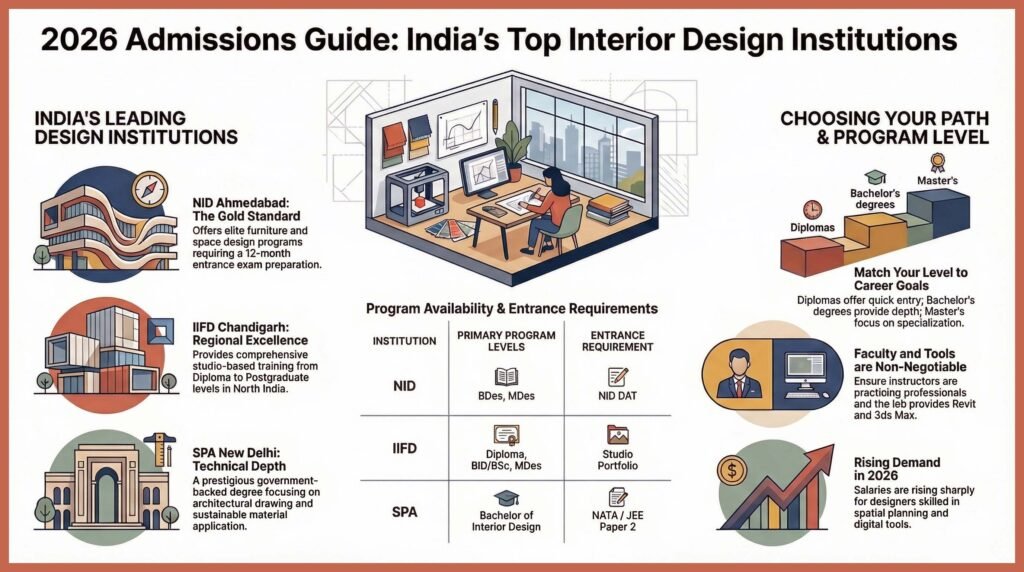
NID holds the top position in nearly every serious ranking of design institutions in India. The interior space and furniture design program covers spatial planning, ergonomics, material science, and production drawing across four years. Faculty members practice design professionally, which means the instruction stays connected to what actually happens on live projects. Clearing the NID DAT entrance exam demands consistent preparation over at least 12 months. Graduates from this program walk into the job market carrying both skills and genuine credibility.
Programs offered: Undergraduate (BDes), Postgraduate (MDes)
IIFD – Indian Institute of Fashion and Design, Chandigarh
IIFD deserves a prominent place on any serious list of interior design institutions in India. As a leading Interior Designing College in Chandigarh, IIFD offers structured programs that take students from foundational design principles all the way through advanced spatial design, material studies, CAD drafting, and professional practice. The institute runs one of the most comprehensive interior courses in Chandigarh, covering diploma, graduation, and post-graduation levels so students can choose the depth of study that matches their career goals.
The faculty at IIFD includes working design professionals who bring live project experience into the classroom. Students get hands-on studio training, software lab access, and industry exposure through internships and live briefs. As a well-established design institute in Chandigarh, IIFD also benefits from the city’s growing commercial real estate and hospitality sector, which creates real internship opportunities close to campus. North Indian students who want serious design education without relocating to Mumbai or Delhi find IIFD a genuinely strong option.
Programs offered: Diploma in Interior Design, Bachelor of Interior Design (BID / BSc), Postgraduate Diploma / Master’s in Interior Design
School of Planning and Architecture (SPA), New Delhi
SPA offers one of the few government-backed interior design degrees in India. The curriculum covers architectural drawing, lighting design, furniture construction, and sustainable material application. Delhi’s location gives students direct access to internship opportunities at architecture firms and design consultancies working across South Asia. Admission runs through NATA and JEE Paper 2, so candidates need to begin preparation well ahead of the application window.
Programs offered: Bachelor of Interior Design
Srishti Manipal Institute of Art, Design and Technology, Bangalore
Srishti takes a deliberately interdisciplinary approach to design education. Students share studio space with product designers, filmmakers, and communication designers, which forces interior design students to think about how spaces communicate emotion and narrative. Graduates tend to land well in experience design, hospitality interiors, and branded retail environments where spatial storytelling carries real commercial value.
Programs offered: Undergraduate (BDes), Postgraduate (MDes)
Pearl Academy – Pan-India Campuses
Pearl Academy runs campuses in Delhi, Mumbai, Jaipur, and Bengaluru. The interior design course teaches AutoCAD, SketchUp, 3ds Max, color theory, spatial planning, and live client briefs. Working on actual industry projects during college builds portfolio pieces that hiring managers respect. Strong industry connections also translate directly into internships and placement support after graduation.
Programs offered: Undergraduate (BA Hons), Postgraduate (MA)
Symbiosis Institute of Design, Pune
Symbiosis offers a well-structured undergraduate program in interior space design. The institute focuses heavily on studio culture, which means students spend significant time building and testing design ideas rather than only reading about them. Pune’s growing design and architecture industry also makes internship sourcing more straightforward than in smaller cities.
Programs offered: Undergraduate (BDes)
CEPT University, Ahmedabad
CEPT runs one of India’s most research-oriented design programs. Students here engage seriously with design theory, urban context, and sustainable building practices. The postgraduate program attracts working professionals who want to deepen their understanding of interior environments within broader architectural frameworks.
Programs offered: Undergraduate, Postgraduate (MID)
What to Check Before You Apply Anywhere
A college’s reputation only tells part of the story. Here is what actually matters before you pay fees or sign an enrollment form.
Faculty practice – Ask whether instructors actively work on design projects or only teach. Practicing designers bring current knowledge into the classroom that textbooks cannot replicate.
Software infrastructure – AutoCAD, Revit, SketchUp, and 3ds Max are non-negotiable professional tools in 2026. Confirm lab access hours and whether licenses cover student use outside class.
Internship placement rates – Request real numbers, not just a list of brand logos on the admissions brochure.
Portfolio or entrance screening – Programs that require a portfolio review or entrance test attract more serious students and maintain higher studio standards.
Alumni visibility – Search for graduates on LinkedIn. Where they work and what they work on tells you more about program quality than any ranking.
Diploma vs. Graduation vs. Post Graduation: Which Level Is Right for You?
Students who want to enter the workforce quickly often choose a diploma program. A one or two-year diploma in interior design provides practical skills and a starter portfolio without a four-year time commitment.
Graduation programs suit students who want deeper knowledge, better job market positioning, and eligibility for postgraduate study later. A bachelor’s degree in interior design typically runs three to four years and covers technical, theoretical, and studio-based learning comprehensively.
Post-graduation programs work best for professionals already working in design who want to specialize, teach, or move into senior roles. An MDes or postgraduate diploma allows focused study in areas like retail design, sustainable interiors, or spatial research.
Start Your 2026 Application Process Now
Several institutions have already opened their 2026 admission cycles. Campus visits, open days, and direct conversations with current students give you information that no website provides. Research carefully, compare programs at multiple levels, and choose the institution that matches both your career goals and your current stage of education.