Ask ten design students in Kolkata why they chose their college, and eight of them will mention infrastructure, faculty qualifications, or fee structure. Rarely will anyone say: “I chose it because I worked on a real project with a real client in my first year.”
That Answer is Rare But It Should Not Be.
I spent the better part of a decade visiting design campuses across eastern India, reviewing student portfolios, and hiring junior designers for projects spanning fashion styling, interior installations, and textile development. What I found consistently surprised me: the most prepared graduates almost never came from the most advertised colleges. They came from institutes where live project experience was baked into the curriculum from semester one — not saved for the final year as an afterthought.
Kolkata, with its extraordinary textile heritage and thriving creative economy, actually hosts some of India’s best-kept secrets in design education. But only a few institutions truly deliver on the promise of real-world training. Here is an honest, experience-backed look at the ones that do.
Why Live Projects Change Everything
Before diving into the colleges, it is worth understanding why live project experience matters so much — because the difference between a student who has done one and a student who has not is visible the moment they walk into an interview.
Live projects teach students to design under constraint. Real clients have budgets, timelines, brand guidelines, and the particular kind of unpredictability that no classroom simulation can manufacture. A student who has navigated even one genuine client brief arrives at their first job with a professional sensibility that takes others months to develop on the job.
The Fashion Design Council of India (FDCI) reports that employers consistently rank practical project experience as the top differentiator when shortlisting entry-level design candidates above academic scores, above software skills, and above portfolio aesthetics alone. That is a significant signal about where the real value of your education lies.
The Design Institutes in Kolkata That Deliver Real Live Project Training: –
1. National Institute of Fashion Technology (NIFT), Kolkata
No conversation about fashion design education in Kolkata begins anywhere else. NIFT Kolkata integrates live projects into its curriculum with a rigour that few other institutions match. Students work directly with textile manufacturers, craft clusters, and fashion brands on assignments that carry genuine commercial weight.
What makes NIFT’s live project model especially valuable in Kolkata is geography. Students collaborate with Bengal’s active hand loom and handicraft sectors — Jamdani weavers, Kantha embroidery groups, Baluchari artisans — and develop collections and product lines that go beyond academic exercises. These outputs reach buyers, trade fairs, and brand sourcing teams. That is real exposure, not rehearsal.
The annual Graduation Fashion Show further cements live project culture — the entire event is student-produced, from concept through execution, in front of a room full of industry professionals.
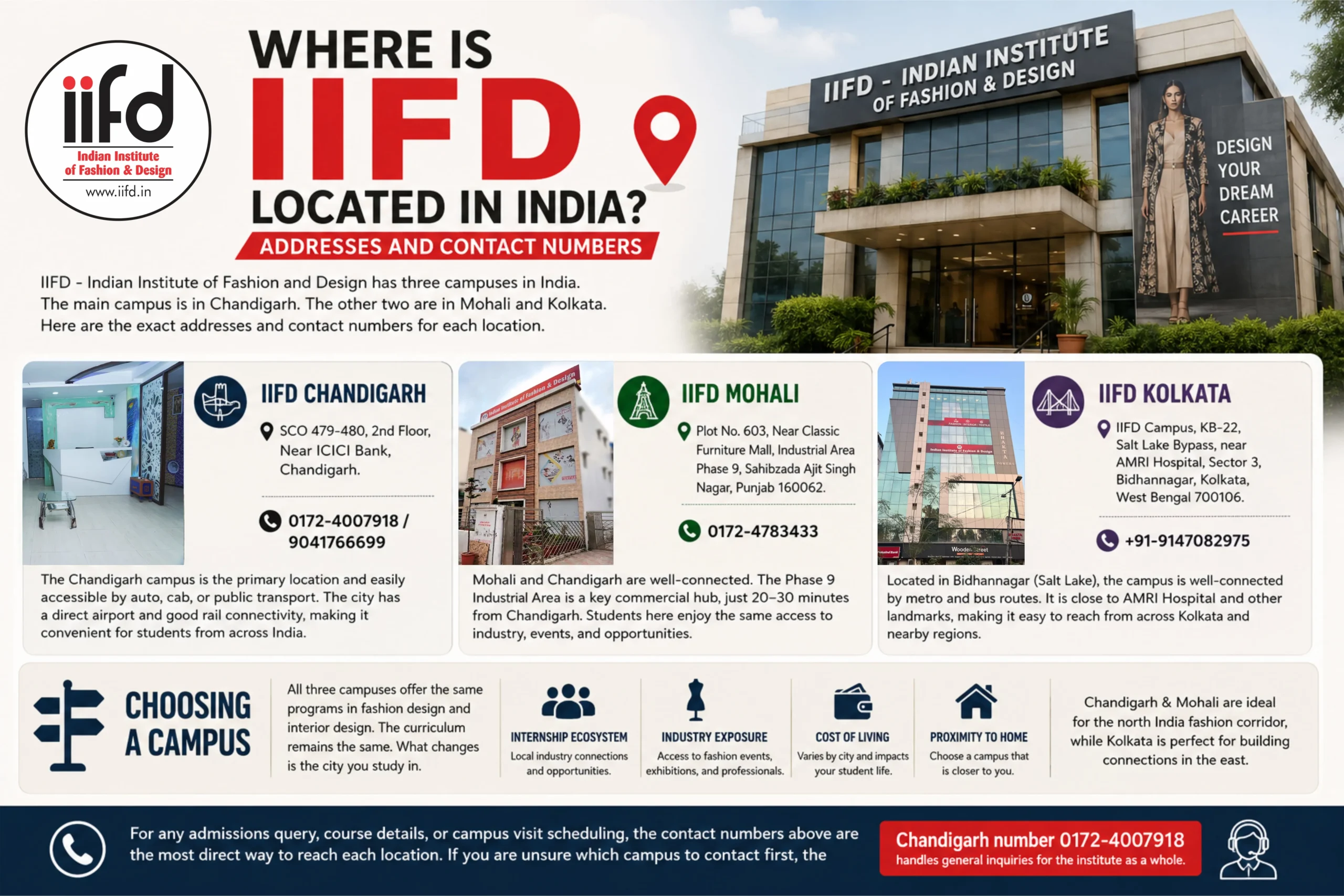
2. Indian Institute of Fashion Design (IIFD), Kolkata
IIFD’s strength in Kolkata lies in its direct connection to the city’s garment manufacturing and export ecosystem. Live projects here often involve sample development for export houses, retail display projects for local brands, and trend-driven capsule collections for commercial clients.
For students who want Fashion Design Courses in India with a clear commercial and manufacturing focus — rather than a purely aesthetic or conceptual one – IIFD delivers a grounded, industry-facing experience that translates well into roles across production, buying, and retail design.
3. ESEDS School of Design
ESEDS carves out a strong reputation in Kolkata specifically for its studio-first, industry-linked approach to interior and fashion design education. Students here engage with live briefs from architects, retail brands, and design studios as part of structured coursework — not as optional enrichment.
What sets ESEDS apart is the regularity of practitioner involvement. Working professionals review student projects, give briefs, and sometimes collaborate on ongoing design work. For students interested in interior design or spatial work alongside fashion, this environment provides exceptional depth of real-world application.
4. JD Birla Institute – Department of Fashion and Textile Design
JD Birla Institute brings something slightly different to live project education: the advantage of a multidisciplinary campus. Fashion and textile design students here regularly collaborate with business and commerce students on project components involving brand development, retail strategy, and market positioning.
This cross-disciplinary live project exposure mirrors how design actually functions inside larger companies, where creative teams rarely work in isolation from commercial ones. Graduates from JD Birla’s design department tend to carry a stronger understanding of the business context surrounding their creative work — a quality that makes them particularly effective in retail and brand environments.
5. GIFT Design Academy
GIFT — the Global Institute of Fashion Technology — has built a curriculum that places significant emphasis on portfolio development through live project work. Students across Fashion design, Interior design, and Jewellery design engage with industry briefs, brand collaborations, and client presentation exercises throughout their programs.
GIFT also participates in fashion weeks and trade showcases, giving students experience of presenting work to external audiences — buyers, journalists, and industry professionals – rather than only to internal faculty panels. That distinction matters more than it might initially seem. Presenting to an external audience with commercial stakes is an entirely different skill from presenting to a professor, and GIFT builds it deliberately.
Three Facts That Should Shape Your Decision
Beyond institutional reputation, the numbers around design education outcomes paint a clear picture:
- According to the National Skill Development Corporation (NSDC), design and fashion students who complete industry-integrated projects during training show a 38% higher job retention rate in their first two years of employment compared to those trained in purely academic settings.
- India’s textile and apparel sector – which directly employs over 45 million people according to the Confederation of Indian Textile Industry (CITI) – continues to generate strong demand for designers who understand both creative development and production realities. Live project experience builds exactly that dual understanding.
- A 2023 survey by the Fashion Design Council of India (FDCI) found that over 65% of hiring managers at Indian fashion and design firms consider live project or internship output the single most important element of a fresh graduate’s portfolio – outranking academic credentials and technical test scores.
💡 Pro Tip
When you attend an open day or campus visit, walk past the reception and spend time in the design studio. Look at what is pinned on the walls – is it abstract academic work, or does it show client briefs, brand names, production specs, and real feedback notes? A studio that looks like it has been used for actual work tells you more about the institute’s live project culture than any presentation slide ever will. Ask students: “Who was the client on your last project?” If they can name one, you are in the right place.
What to Verify Before You Sign Up
Many Design Institutes in India have added “live projects” to their marketing materials over the past few years. That makes due diligence more important than ever. Before committing to any program, ask the institution to share:
- Documented project outcomes from the last two academic years — which brands or clients were involved, what was produced, and how it was used.
- The names of at least three industry partners the college currently works with on student projects — and verify those partnerships independently if possible.
- The average number of live projects completed per student before graduation. One project across three years is not a live project culture; it is a checkbox.
- The Fashion Design Institute in India that earns your fees should be able to answer all three of those questions without hesitation.
The Real Advantage Kolkata Offers
Kolkata holds a creative advantage that students from other cities often underestimate. The city sits at the centre of Bengal’s extraordinary craft economy hand loom textiles, block printing, terracotta work, Dokra metal craft — and the best design institutes here tap directly into that ecosystem for live project material.
That means Kolkata students working on live projects often develop fluency in traditional crafts alongside contemporary design practice – a combination that is genuinely rare, commercially valuable, and deeply distinctive in a national portfolio.
Choose wisely. The right institute will not just teach you to design. It will put you in rooms where your design decisions have real consequences – and that, more than any course syllabus, is where a career actually begins.